
1. Define the contractor journey
Start with the work population: construction crews, maintenance teams, delivery drivers, specialist service providers and subcontractors. Identify which groups need the shared induction and which require an additional task or location briefing. An escorted visitor should not have to navigate a contractor’s entire work-control module.
Separate four decisions: permission to enter, understanding of site rules, competence for the assigned task, and authorisation to perform the work. Watching a video does not, by itself, establish the other three. Record where the film sits in your contractor onboarding process.
From arrival to authorised work
- 01Before arrival
Confirm the contractor group, required documents and briefing language.
- 02Site induction
Explain the site, critical risks, reporting and emergency arrangements.
- 03Task preparation
Link the approved task briefing, competence and permit requirements.
- 04Understanding and records
Check comprehension, record the correct version and confirm the next authorisation step.
2. Build the source pack before the script
Ask HSE and the relevant operational owners for the current site induction, contractor HSE requirements, emergency response plan, approved maps, permit-to-work arrangements, risk assessments and applicable work instructions. Include the language requirements and the actual forms or systems people will use.
HIRARC means Hazard Identification, Risk Assessment and Risk Control. A JSA, or Job Safety Analysis, examines the steps and hazards of a particular job. Use the terminology and document structure adopted by the site. The film should connect these controls to the contractor’s experience without trying to reproduce every technical work instruction.
Create a source register with a document owner, revision, site applicability and linked scene number. Where documents disagree, refer the issue to the HSE owner before scripting the instruction. Keep unconfirmed emergency contacts, routes and technical values out of the final voice-over.
3. Give every module a clear job
PurplePerfect’s Gas Malaysia Site HSEQ Briefing script, dated 24 December 2024, organised contractor and external-personnel content around the project overview, emergency response, Mission Zero, Life-Saving Rules, incident and unsafe-condition reporting, contractor obligations and duty of care. It also planned a QR route to attendance and assessment.
The useful production principle is the relationship between the modules: establish context, explain critical controls, assign responsibilities, then check understanding. The table below is a commissioning framework to adapt with your HSE team; it is not a replacement for a facility’s procedures.
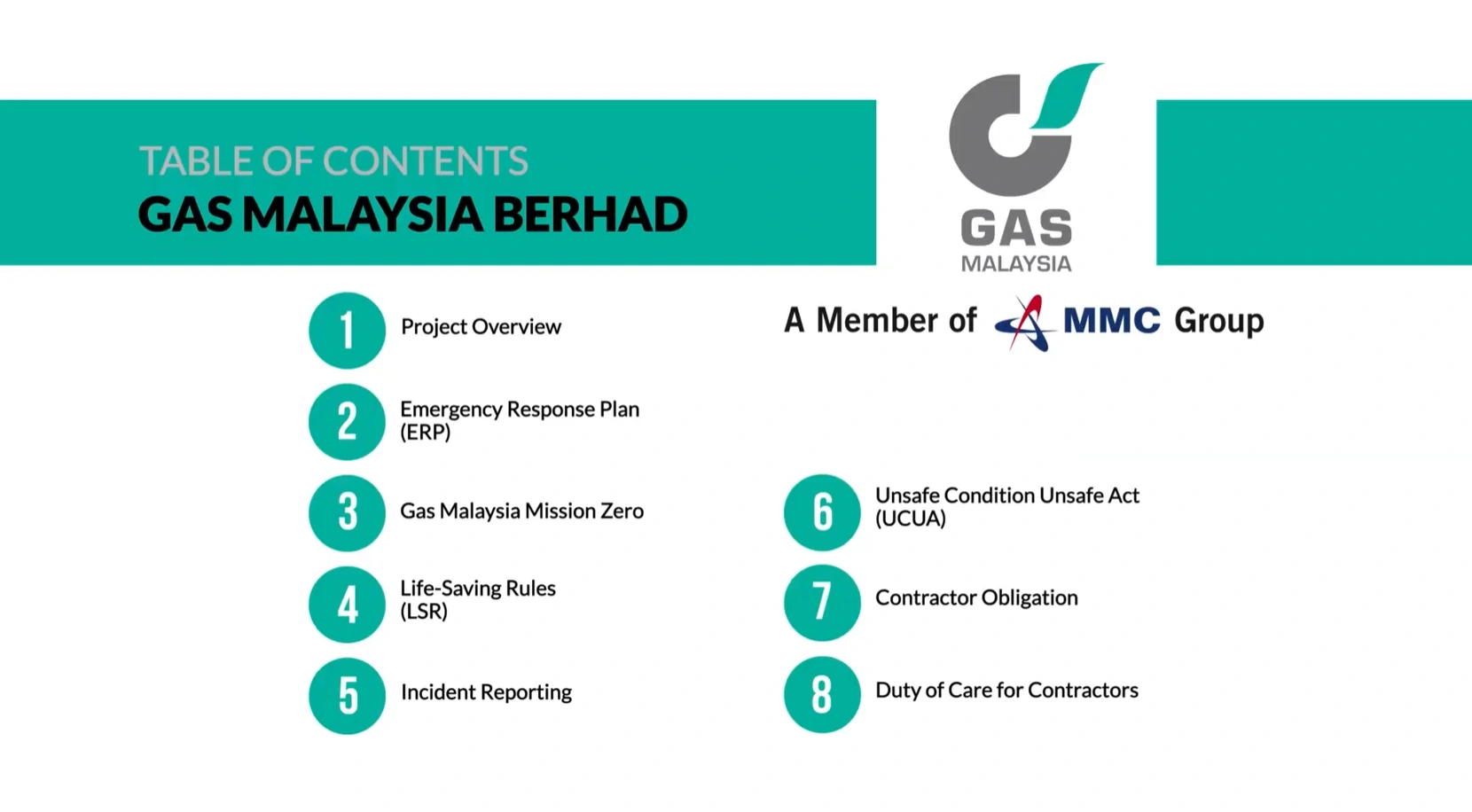
| Module | What the viewer needs to understand | What HSE should supply |
|---|---|---|
| Entry and work context | Which site, project, role and access boundaries apply? | Approved site map, access process, scope and responsible contacts. |
| Critical risks and controls | Which hazards and Life-Saving Rules are relevant to this work? | Current HIRARC/JSA references and approved examples. |
| Work authorisation | Which activities need further briefing, competence checks or a permit? | Current PTW and task-control arrangements, with role boundaries. |
| Emergency response | How will I recognise and respond to the site’s emergency arrangements? | Approved ERP, alarm meanings, routes, assembly and accountability process. |
| Reporting and intervention | How do I raise an incident, near miss, unsafe condition or unsafe act? | Definitions, reporting channels, escalation and authorised restart wording. |
| Contractor responsibilities | What must my employer, supervisor and work team provide or maintain? | Applicable requirements for training, supervision, PPE, equipment, environment and records. |
| Understanding and follow-through | What must I demonstrate, and what happens if I need help? | Approved assessment, briefing support and attendance/version records. |
The source script separated contractor responsibilities into 13 areas, covering governance, risk assessment, communication, training, PPE, environmental protection, reporting, equipment condition, housekeeping, inspection access, work suspension and security. That breadth should inform the content map. It does not mean thirteen equally long narration sequences: some messages belong in a supervisor module, a job briefing or supporting reference material.
4. Explain work authorisation without blurring responsibilities
The permit-to-work (PTW) section should help contractors recognise the authorisation boundary: what work is controlled, who carries the relevant responsibilities, where to obtain the approved instruction and what changes require escalation. Have the permit-system owner validate the language and the visual sequence.
Plan relevant examples with HSE: energy isolation and lockout/tagout (LOTO), hot work, confined-space entry, lifting operations, work at height, excavation and simultaneous operations (SIMOPS). Explain only the topics that apply. Do not give a general induction the appearance of task certification or a live permit.
For each topic, decide what a contractor needs to recognise, what they must confirm and where the detailed task instruction sits. Avoid inventing gas-test limits, exclusion distances, lifting capacities or rescue steps. Those values and procedures must come from the controlling documents and their authorised owners.
5. Show hazards and controls in the same scene
An HSE manager should be able to inspect the storyboard and see how each important message becomes visible. A narration about safe access needs the right route and boundary on screen. A PPE instruction needs equipment that matches the task and site. A beautiful photograph with contradictory behaviour weakens the instruction.
| Approach | Useful when | Plan for |
|---|---|---|
| Live filming | The real setting or demonstration matters. | Access, approved behaviour and repeatable coverage. |
| Animation | A relationship or message needs visual explanation. | Accurate diagrams, actions and technical review. |
| Combined | The viewer needs both context and explanation. | Consistent terminology and one coherent sequence. |
Use the real site for orientation and approved demonstrations. Use animation for hidden relationships, process boundaries or concise explanations. Use screen text for the one action the viewer should retain. Keep narration, captions and the action on screen aligned; a correct script cannot rescue an incorrect demonstration.
For chemical topics, use the applicable Safety Data Sheet (SDS) and approved chemical-risk information. For traffic and mobile plant, show the actual pedestrian interface and site-approved signals. For ports, confirm how the induction covers quay edges, mooring areas, cargo movement and restricted zones with the port team. These are topics to validate, not generic instructions to transfer between facilities.
6. Make emergency and reporting information usable
The Emergency Response Plan (ERP) module needs the current alarm meanings, evacuation or other protective actions, approved routes, assembly arrangements, accountability process and emergency contacts. Check the actual site layout against the map used in the animation. The responsible team must resolve what happens when the primary route or assembly point is unavailable.
Distinguish an incident, a near miss, an unsafe condition and an unsafe act using the organisation’s approved definitions. Explain the reporting channel, responsible contact and required records. Use the client’s own response times and escalation rules only after verification; another project’s deadlines are not a safe default.
The film should make it easy to raise a concern. Show what happens after the report and identify the authority for any restart. Have HSE confirm the precise stop-work and restart wording so that a production edit does not accidentally narrow or expand a person’s responsibility.
7. Review the whole instruction, then test understanding
Review each scene as a complete unit: source document, narration, screen text, depicted behaviour, language version and approval owner. Include operational supervisors as well as the HSE reviewer when their work is being shown. They may notice an incorrect access route, equipment state or sequence that a copy review misses.
One scene. A complete safety message.
- 01Source
Document, revision and site applicability.
- 02Instruction
One principal action in plain language.
- 03Visual
Correct setting, equipment, behaviour and boundary.
- 04Review and release
Technical approval, language check and comprehension evidence.
Use plain words first and introduce technical terms in context. Select language versions for the actual workforce; subtitles alone may not solve literacy or reading-speed problems. Technical reviewers should check translated meaning, not just grammar. Trial the film on the screen and in the setting where induction will take place.
An attendance record confirms participation. A comprehension check asks whether the person understood. Task competence and permission to work need their own verification. Ask the HSE owner to define the questions, pass criteria, support for unsuccessful learners and records to retain. Do not invent a universal pass mark.
8. Plan updates and controlled handover
Agree who owns the released version, which sites it covers and when it must be reviewed. Typical review triggers include changed work processes, access routes, emergency contacts, site rules, incident learnings or language needs. Put frequently changing information into clearly identifiable modules.
At handover, request the agreed master exports, language files, subtitle files, scene/source register and version list. Confirm whether editable project files are included and whether their fonts, music, footage and other assets can legally be transferred. Remove obsolete induction versions from the delivery channels under your control.
Ready to brief your producer?
- Contractor groups, subcontractor coverage and site-specific modules defined.
- Current HSE documents, HIRARC/JSA references and technical owners identified.
- PTW, competence and site-entry responsibilities clearly separated.
- Relevant high-risk work, interfaces and environmental topics mapped.
- ERP maps, contacts, reporting channels and escalation wording verified.
- PPE, equipment state and demonstrated behaviour approved on screen.
- Language, subtitle and comprehension checks planned for the actual workforce.
- HSE, operations and final-release sign-offs assigned.
- Attendance, assessment and version records agreed.
- Update triggers, licensing, editable-file scope and handover responsibilities recorded.
Separate the audiences before counting the versions
A visitor briefing covers the escorted visit, site rules and emergency actions. Contractor induction also needs the work boundaries, authorisation process and task-related responsibilities relevant to that group. Employee onboarding may require a different depth. Confirm the common core and audience-specific modules with the site HSE owner.
List each language against its audience. Choose live action when the real location or demonstrated action matters; use animation for hidden processes or scenarios that cannot be staged safely. Check translated terminology, narration and subtitles together with a competent language reviewer and the designated technical approver before release.
This is a guide to commissioning safety communication. Your site’s authorised procedures and HSE team govern the operational content. HSE’s contractor-management guidance provides a useful international reference on induction, responsibilities and contractor interfaces; it is not Malaysian legal guidance.
Share your existing induction and the contractor groups you need to reach. We can help turn the approved material into a scene plan your HSE and operations teams can review together. Explore the Gas Malaysia project.