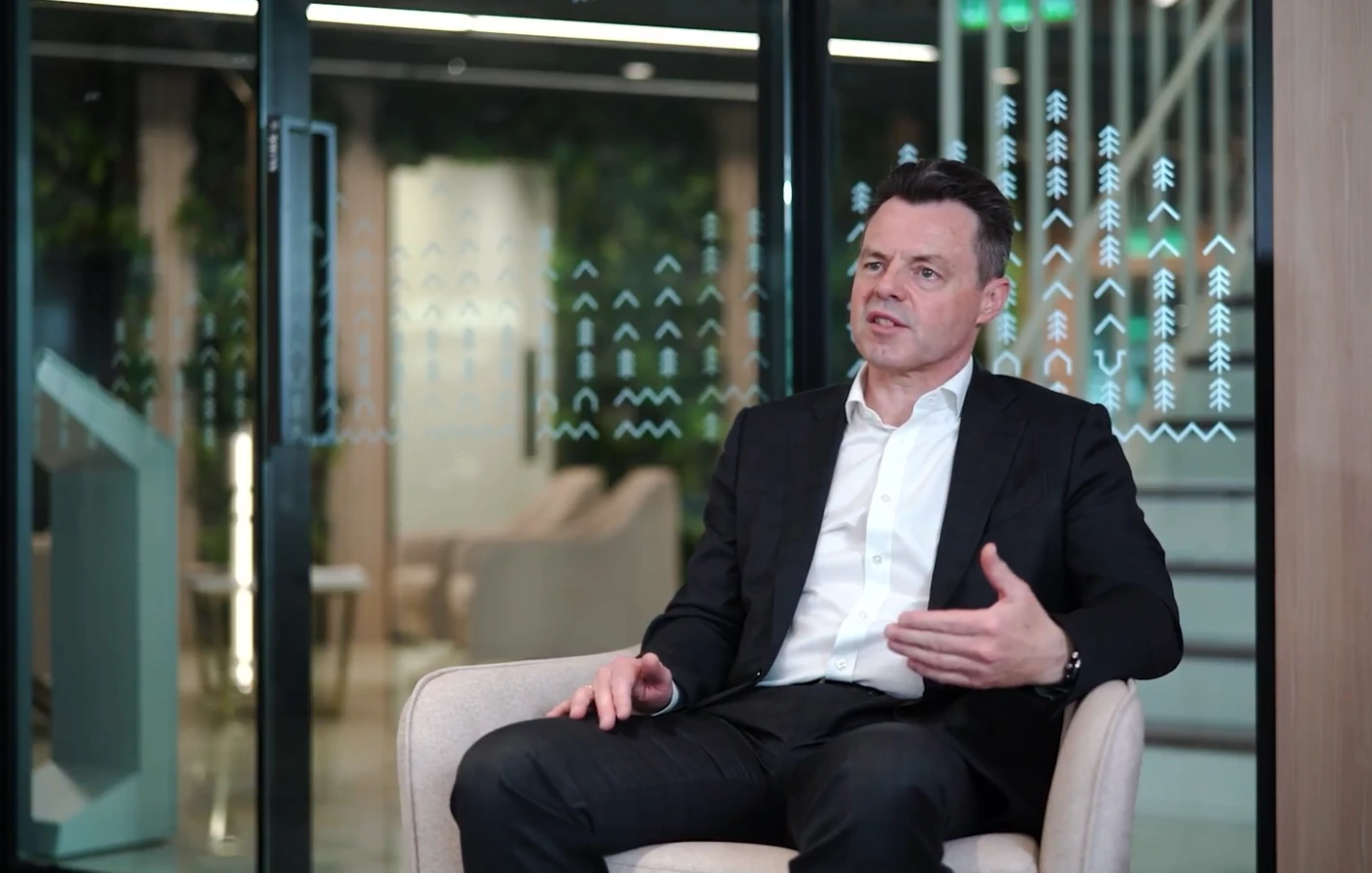
Decide what the speaker must help the audience understand. Prepare questions that invite examples, choose a quiet and relevant setting, make the person comfortable, and check sound before recording. Plan the supporting pictures and approvals as carefully as the interview itself.
A good interview gives the film something it cannot get elsewhere
A CEO can explain a decision. A researcher can make a complex idea understandable. An employee can describe what changed in practice. Before booking the room, write down the contribution only this person can make. That is a more useful brief than “we need a few sound bites”.
This collection brings together four PurplePerfect project contexts: Expro, T7 Global’s ELISE MOPU film, UTP Research & Innovation, and Yinson’s AGM film. The project notes describe the assignments; the checklists and setup diagrams are practical guidance for planning a similar interview, not a record of every technique used on those shoots.
The interview planning sequence
- ContributionWhat should this person help the viewer understand?
- ConversationWhich question will uncover a specific, truthful example?
- CoverageWhat pictures and approved facts will support the answer?
Four projects. Four useful planning lessons.
01 / Expro
Give a reflective interview room to develop
- Project context
- An interview-led story assignment with Expro.
- Buyer’s question
- How do we get meaningful answers from people who are not professional presenters?
- Planning lesson
- Share themes ahead of time, then ask about an event, a decision and its consequence. A speaker recalling something specific has more to work with than someone asked to recite a list of corporate values.
Try asking: “Can you take me back to a moment when the team had to solve a difficult problem?” Follow with “What did you do?” and “What changed?” Allow the answer to finish before choosing the follow-up.
02 / T7 Global · ELISE MOPU
Protect the purpose when a leadership interview has a deadline
- Project context
- A CEO interview contributing to the MOPU film prepared for an annual-dinner screening.
- Buyer’s question
- What if the executive’s availability falls close to the event?
- Planning lesson
- Agree the essential contribution, fact owner and review window before filming. Capture the indispensable answer first, then record optional supporting material. Leave time to check the final screening file.
Prepare: a short question route, approved names and project terminology, available supporting footage, and one person who can consolidate comments. A tighter deadline needs a more focused scope.
Explore the ELISE MOPU project →
03 / Universiti Teknologi PETRONAS
Help the expert explain significance before specialist detail
- Project context
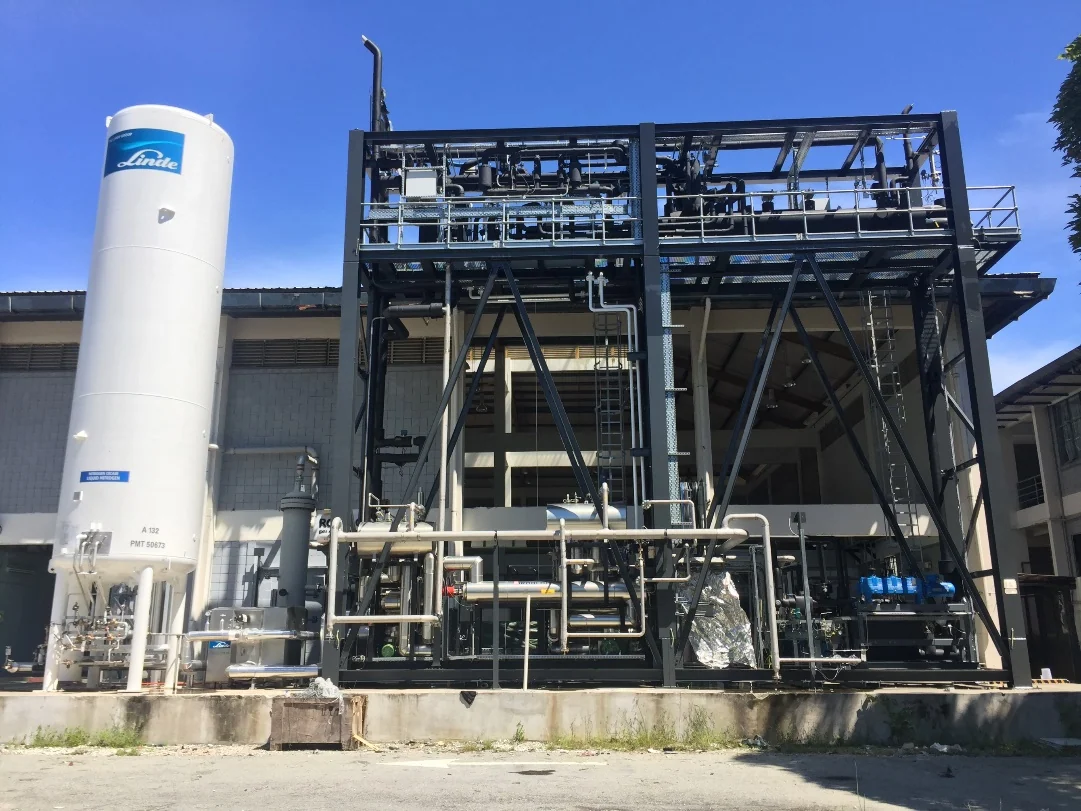
- Researcher and customer interviews formed part of UTP Research & Innovation film development, with institutional review.
- Buyer’s question
- How do we make a technical subject accessible without oversimplifying it?
- Planning lesson
- Ask what problem the work addresses, how it works and what evidence supports its significance. Then identify the terms and qualifications that must survive the edit.
Try asking: “What could someone do differently because of this research?” Let the specialist define the boundaries. A demonstration or annotated process can support an explanation; it cannot stand in for evidence of performance.
Explore the UTP project →04 / Yinson · AGM communication
Plan consistency when contributors are in different places
- Project context
- The AGM film development involved in-person interviews, supporting footage and a remote interview contribution.
- Buyer’s question
- Can remote and filmed interviews belong in the same finished story?
- Planning lesson
- Send a shared recording brief and run a technical rehearsal. Agree framing, eyeline, background, sound, recording method and file transfer. Editorial consistency comes from the questions and intended message as well as the camera.
Prepare: a locally recorded file where practical, headphones for the call, a quiet room, stable power and a backup plan. Check a sample before the executive joins. Be honest about quality differences instead of promising that every recording can be made identical.
Explore the Yinson project →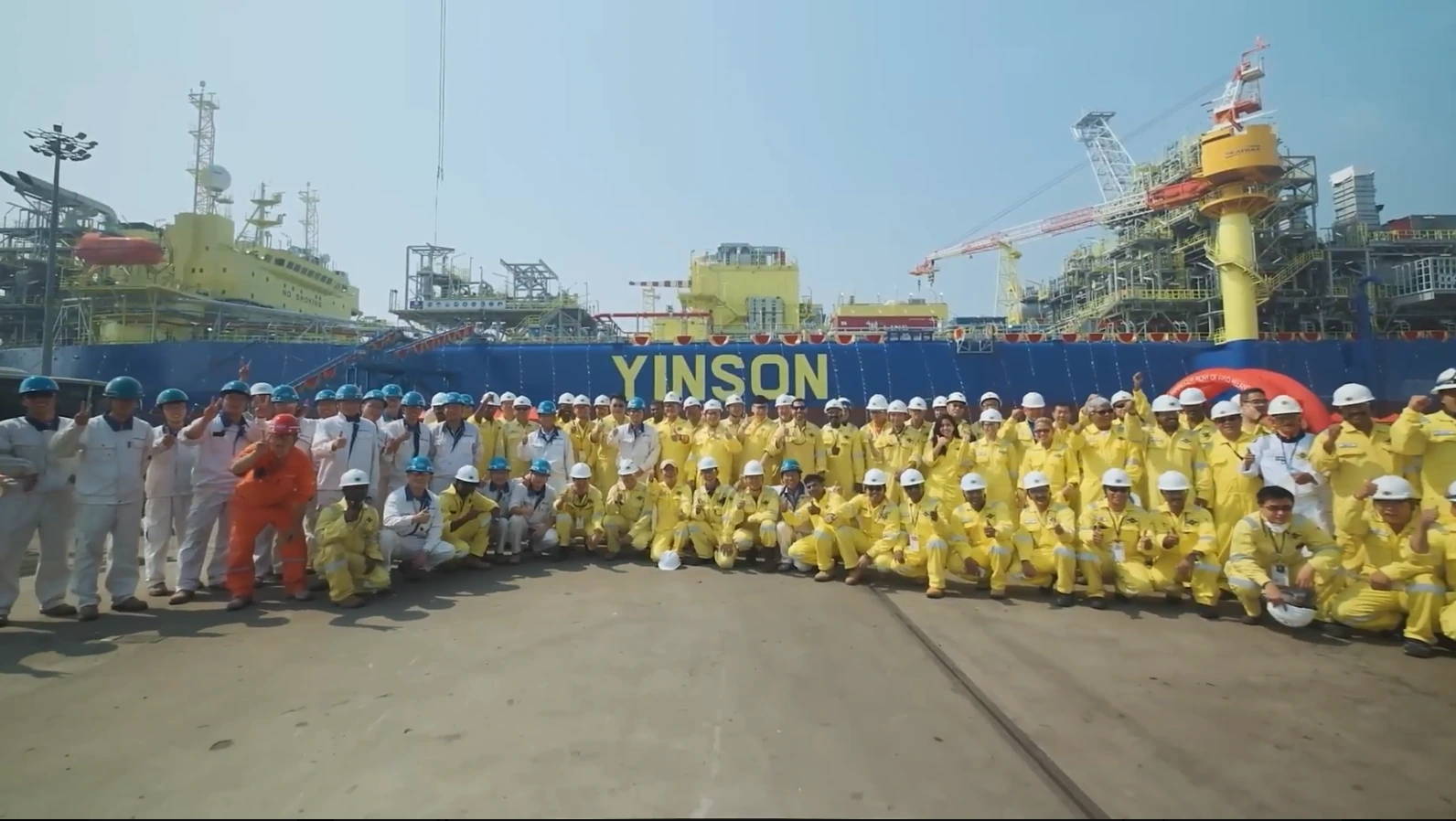
Ask questions that lead to usable answers
Prepare a route through the conversation, rather than a script the interviewee must memorise. Begin with an easy question, move into specific experience, and close with what matters next. Avoid putting an answer into the speaker’s mouth.
| Instead of stopping at… | Ask… | Listen for… |
|---|---|---|
| “Tell us about your company.” | “What problem do customers come to you to solve?” | A relevant reason for the company to matter. |
| “Are you innovative?” | “What did you change when the usual approach was not enough?” | A decision, mechanism and example. |
| “Was the project successful?” | “What was delivered, and how do you know it met the requirement?” | Evidence with a clear scope. |
| “What are your values?” | “When did that principle affect a difficult choice?” | Behaviour that makes the value believable. |
If the questions will be removed in editing, ask the speaker to include enough context for the answer to stand alone. “We introduced the check because…” is easier to use than “Yes, that’s right.” Let people speak naturally first; ask for a shorter version after you understand what they mean.
Worked example / illustrative, not a client quotation
Turn “We are reliable” into an answer worth using
Imagine interviewing a manufacturing operations manager. Asking “Are you committed to quality?” will probably produce a broad assurance. Your job is to uncover an observable process without feeding the speaker a predetermined answer.
Start with a real situation
“What happens when an inspection result is outside the agreed tolerance?” This invites an explanation of a decision, not a slogan.
Follow the sequence
“Who sees the result? What happens to that batch? Who can authorise its release?” Ask one question at a time and follow the person's actual answer.
Find the customer meaning
“Why does that step matter to the customer receiving the component?” If the answer is abstract, ask for an approved example or a concrete explanation.
Plan the supporting pictures
The editor may need the inspection, status identification, escalation and review. Check what can genuinely be filmed and what must be redacted. A generic machine montage does not demonstrate this particular process.
Protect the meaning in the edit
Keep qualifications such as “for this product line” or “under the agreed inspection plan.” Removing them can turn an accurate answer into an unsupported company-wide claim.
Try this before your shoot
Write one broad claim you hope the interview will support. Under it, write three questions: What happened? How did you handle it? Why did that matter? Then list the specific pictures that would help a viewer understand the answer.
If you cannot identify the evidence, investigate further before writing the conclusion.
Choose the audience relationship before the camera setup
Beside the lens: the speaker talks to an interviewer close to the main camera. This suits a reflective conversation. Into the lens: the speaker deliberately addresses the viewer. This can suit a leadership message, invitation or clear commitment. Neither eyeline guarantees authenticity; comfort and truthful delivery matter.
Choose a supportive chair or comfortable standing position first, then adjust the lens height. Give the person a clear eyeline. For two-camera conversations, protect the conversational axis and use a meaningfully different frame. A side-angle cut during direct address visibly changes the relationship with the viewer.
01 / Executive Documentary
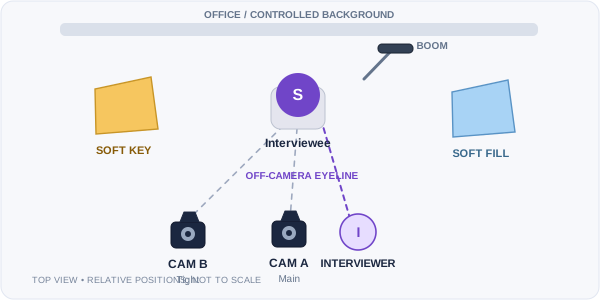
PORTRAIT EFFECT Medium close-up, confident and thoughtful; conversational eyeline slightly beside Camera A.
USE FOR Leadership stories, annual reports, boardroom narratives
WATCH Do not position interviewer too far from A; the profile becomes overly turned.
02 / Direct-to-Lens Address
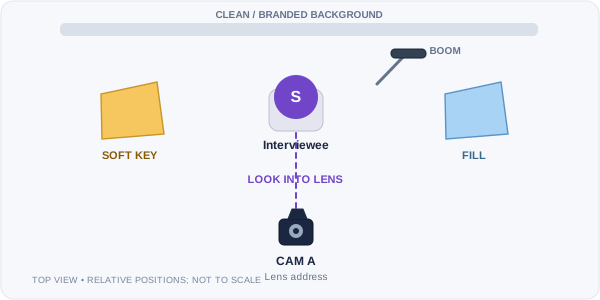
PORTRAIT EFFECT Centred, symmetrical portrait; subject speaks directly into Camera A.
USE FOR CEO messages, brand promises, campaign closing statement
WATCH Avoid cutting to a side angle while maintaining the illusion of direct eye contact.
03 / Intimate Heritage Portrait
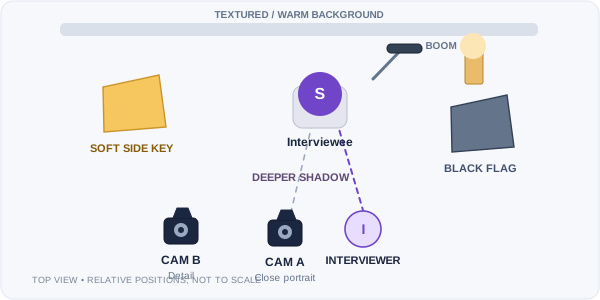
PORTRAIT EFFECT Tight, reflective portrait; deep but controlled shadow, soft background practical.
USE FOR Founder biography, long-service staff, emotional testimony
WATCH Avoid low, deep seating that collapses posture and obscures facial expression.
04 / Human Environmental Interview
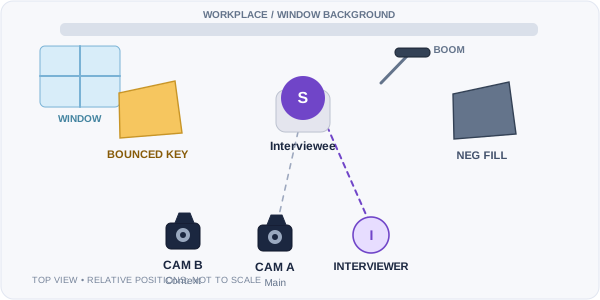
PORTRAIT EFFECT Medium portrait including workplace context and gestures; motivated natural-looking light.
USE FOR Employees, craftspeople, studio teams, company culture
WATCH Window and background light can change; lock white balance and control exposure.
05 / Standing Expert / Site
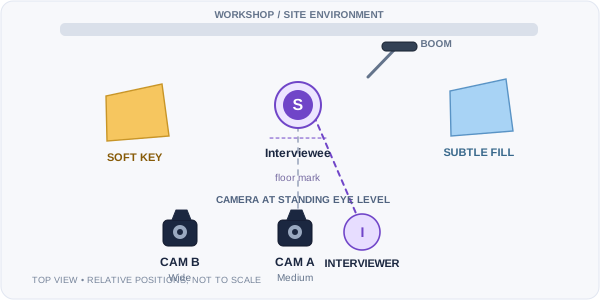
PORTRAIT EFFECT Medium or waist-up framing, open body language, room for hands and environment.
USE FOR Engineers, site directors, process demonstrations, active subjects
WATCH Do not film too long in one position; watch foot shuffling, sway and changing light.
06 / Two-Person Conversation
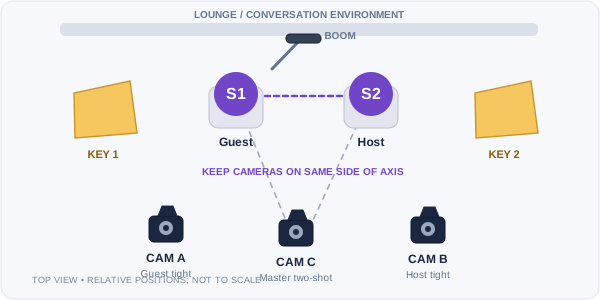
PORTRAIT EFFECT Master two-shot plus respectful close-ups; speakers naturally face one another.
USE FOR Leadership dialogue, expert conversation, interview-led series
WATCH Preserve the 180-degree axis; check furniture height and overlapping gestures.
These plans are schematic starting arrangements, adapted from the supplied PurplePerfect Interview Portrait Setup Atlas. Positions are relative, not to scale. Adjust for the room, speaker, access needs and approved site arrangements.
The decisions behind the picture
Five choices that change how an interview feels
A successful interview needs a clear contribution to the story and a setup that helps the person deliver it. Before discussing cameras, finish this sentence: “This person can help our audience understand ___ because they have experienced or know ___.” That is more useful than asking every contributor for an overview of the company.
Who is the speaker talking to?
Looking just beside the lens creates a conversation with an interviewer. Looking into the lens addresses the viewer directly. Choose the relationship that suits the message and rehearse it. A nervous speaker may be more comfortable answering a person than delivering a statement to a camera.
How much context is useful?
A medium frame leaves room for hands and the environment. A closer frame makes small expressions more visible. Use a second angle when it offers a purposeful change in emphasis or helps the edit; it also adds equipment, matching and data-management work.
What should the viewer notice?
A large, diffused key light can give a gentle transition across the face. Fill light lifts the shadow side; negative fill absorbs reflected light and deepens it. Neither “bright” nor “dramatic” is automatically appropriate. Check skin, glasses, background and brand tone together.
Can the audience follow every word?
Listen for reverberation, ventilation, traffic, fabric and jewellery. A better microphone does not remove a poor acoustic environment. Record a test, listen on headphones and deal with the noise before the main interview.
Does the setting help the story?
A real workplace can explain a person's role, but movement and machinery can distract. A quiet room may be the better interview location, with separate operational footage providing context. A stable chair, comfortable posture and planned breaks help the speaker sustain the conversation.
For the client: approve the audience relationship, background and sample frame before the principal contributor arrives. This protects their time and leaves the interview slot for the conversation.
Make the voice easy to hear and the person comfortable
- Choose the room with your ears.Listen for air-conditioning, traffic, refrigerators, reflective surfaces and interruptions. Record a test and listen on headphones before committing to a visually attractive room.
- Place and monitor microphones.A suitable boom just outside the frame and a carefully fitted lavalier can provide separate options. Check fabric rustle, jewellery and head turns. Two microphones only provide useful backup if their tracks are actually recorded and checked.
- Test the complete picture.Check focus, skin exposure, reflections, eyeline, background detail and power. Match cameras deliberately. A 25p / 1/50 workflow can be a useful starting point under 50 Hz lighting; test the actual LEDs and screens for flicker rather than assuming it is solved.
- Direct a person, not a performance.Explain where the answer will be used. Give permission to pause, restart or correct a fact. Keep the set calm, offer breaks and adapt seating to the person’s needs. Do not turn a genuine emotion into a requested repeat performance.
- Leave a path through the edit.Record room tone and specific B-roll. Capture the process, object or environment the answer refers to. Obtain a short clean restatement if a valuable answer depends on a question the viewer will not hear.
Technical starting points to discuss with your crew
You do not need to specify every camera setting to commission an interview. You should understand the trade-offs that affect consistency, clarity and the final versions.
Camera, exposure and multi-camera continuity
The supplied production playbook uses 25 fps with a 1/50-second shutter as a starting point for filming in Malaysia's 50 Hz environment. LED fixtures and screens can still flicker: test the actual lighting and adjust accordingly. This is a capture starting point, not a universal social-media export rule.
A roughly 50–85 mm full-frame-equivalent focal length and an aperture around f/2.8–f/4 may suit some seated portraits. Space, sensor size, movement and the intended depth of field change the choice. A very shallow focus plane can turn a natural lean into a soft shot.
Match white balance, frame rate and the intended colour workflow across cameras. Keep camera angles on the same side of the conversational axis. For direct-to-camera delivery, a side angle changes the apparent eye contact, so decide whether that cut serves the film.
A 4K recording can offer reframing flexibility for a lower-resolution delivery, but it does not guarantee a good vertical crop. Leave suitable composition space and check the intended outputs in advance.
Audio, seating and the pre-roll check
Where practical, record a boom and lavalier to separate tracks so the editor can choose the cleaner source. The playbook's 48 kHz/24-bit recording and ordinary speech peaks around −12 to −6 dBFS are useful starting points, with headroom for louder answers. Recording peaks are not the same thing as final programme loudness.
Ask the speaker to speak at their natural interview level during the test. Check for clothing rustle, microphone contact and clipping; monitor the entire recording. Capture room tone for editing, but do not treat it as a cure for ongoing noise.
Use stable seating, comfortable feet and an eyeline the speaker can maintain. Mark positions discreetly, offer breaks and check cables and equipment placement. Record a short test with all cameras and microphones, then play it back before the important answers begin.
Why clear pictures and words belong together: Fiorella and Mayer's review of multimedia-learning principles (2021) describes benefits from excluding irrelevant material and directing attention to essential information. Our production application is to show the process being explained and identify the important step. Educational findings do not establish that a particular interview style increases enquiries.
Protect meaning during editing and approval
Build a transcript or paper edit around the story contribution. Keep qualifications, time periods and context that affect the meaning. Combining fragments must not make someone appear to endorse a claim they did not make. If a statement is uncertain, ask the factual owner to resolve it.
Agree who checks facts, who reviews brand language and who gives final approval. Supply one consolidated set of time-coded comments. Verify names, titles, subtitles, translated terminology and permissions for the intended channels before release. An interview release and music or footage licences are separate items.
Use the stakeholder approval approach when several departments need to review the film.
Your interview-day readiness check
Use this with your producer or internal team. The ticks stay on this page for the current visit; they are not submitted or saved.
Before you press record
Can we film the interview internally?
Yes, if the purpose is contained, the environment is controllable and your team can test the full workflow. A capable internal interviewer, a quiet room and a carefully checked recording can be enough for a useful employee update.
Bring in specialist support when the session cannot easily be repeated, several executives or locations must be coordinated, the setting is noisy or operational, or the final film needs substantial story development. A hybrid approach can work: your team prepares contributors and facts; the production team handles direction, recording and editorial continuity.
Brief against the required outcome, not a camera count. Specify contributors, locations, expected interview time, supporting coverage, versions, review responsibility and final use. These choices shape the production budget.
Questions clients ask before an interview shoot
Should we send questions in advance?
Usually share the themes, purpose and factual preparation needed. Use a detailed question list when accuracy or sensitivity requires it. Avoid requiring memorised answers for a conversational interview unless a formally approved statement is necessary.
Should our CEO use a teleprompter?
A teleprompter helps with an exact, approved direct address. Talking points and a near-lens interviewer may suit reflection and personal experience better. Try a short rehearsal and choose the method that supports accurate, comfortable delivery.
How long should we reserve?
Allow separate time for setup and testing, the conversation, supporting footage and breaks. A short finished excerpt can require a much longer conversation. Confirm a schedule around the number of themes and contributors rather than estimating from the final runtime alone.
Do we need two cameras?
Not always. Two cameras can give useful editorial alternatives for a conversation. One well-managed camera can suit a focused direct address. Sound, the quality of the answers and relevant B-roll often deserve attention before an extra angle.
Sources and further reading
Practical guidance developed from PurplePerfect’s supplied interview-production playbook, interview guide and portrait setup atlas. Project contexts draw on the project archive and the linked case studies.
- Sony: reducing camera flicker — check the camera and actual lighting rather than relying on a single shutter setting.